Energy & Utilities Process Improvement
How utilities are modernizing wildfire mitigation programs
For many years, wildfire mitigation was viewed primarily as a West Coast issue. Today, that perspective has changed…
Read article


Energy & Utilities Data & Analytics
05/13/2026
by Alex Hill and Meghan McCahill

Texas continues to face volatile winter and summer peak demand risks, with increasing variability in extreme weather patterns impacting reliability. In an effort to make the grid more resilient to extreme weather conditions, utilities are investing heavily in advanced analytics, AI-driven modeling, and next-generation resiliency technologies to strengthen grid performance. These capabilities are delivering powerful insights—pinpointing high-risk assets, predicting failures, and optimizing where to invest. Yet, many organizations are running into the same barrier: the last mile problem. Despite better data than ever before, insights often remain trapped in standalone tools, disconnected from capital planning systems, and not utilized in conjunction with existing operations knowledge or best practices.
The challenge isn’t a lack of technology—it’s the gap between insight and action. Without aligned workflows, clear ownership, and strong adoption across engineering, operations, and technology, even the most advanced analytics struggle to translate into measurable outcomes. Leading utilities are now focused on closing this gap to turn insight into real-world resiliency impact.
Even with strong analytics capabilities, utilities often face numerous challenges.
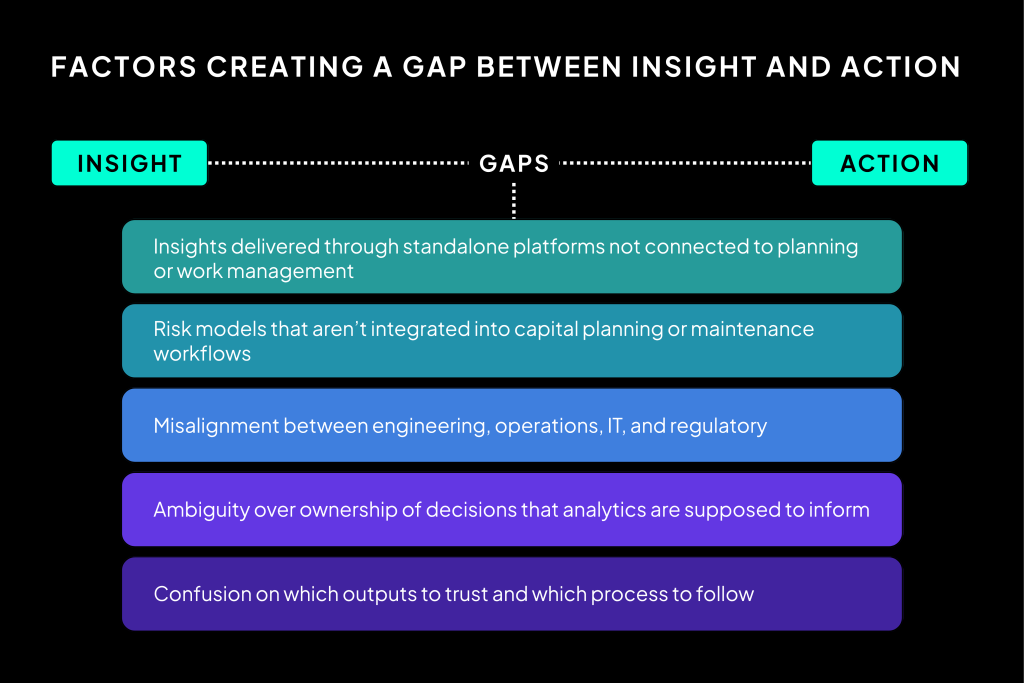
In addition to these roadblocks, today’s reality layers on another challenge: Technology is changing so quickly that frontline employees often experience change fatigue—making them less eager to adopt new tools and more likely to fall back on familiar, legacy systems.
Turning insights into action requires more than advanced analytics. It requires the right combination of technology alignment, workflow integration, people readiness, and disciplined execution. These elements work together, and the utilities that close the last‑mile gap approach them as a connected system rather than standalone activities. Here’s how:
Utilities often struggle with application sprawl—overlapping systems, legacy tools, and inconsistent usage across teams. Over time, this creates confusion about which system is the source of truth and which insights should actually drive decisions. Leading utilities are addressing this by taking a more intentional approach to their technology landscape: identifying and rationalizing the full suite of tools used across business units, eliminating redundant or low-value applications, and aligning new technology investments to clearly defined business capabilities. They also prioritize cross-functional input and process mapping to ensure that new analytics tools are not layered on top of outdated workflows, but instead support an optimized, future-state operating model with standardized, trusted outputs.
Tactical actions:
Analytics are most useful when they’re part of everyday work, not something teams have to check separately. Instead of relying on standalone dashboards, the goal is to place insights directly into planning and operational workflows where decisions already happen. If it’s something people have to remember to check, they likely won’t.
There are a few areas where this kind of integration matters most. In capital planning, analytics can support risk‑based asset prioritization. In maintenance planning, they can help focus attention on higher‑risk assets. For storm planning, predictive information can inform resourcing decisions and staging plans before events occur.
Making this work comes down to how the analytics are designed and delivered. Insights should show up in the systems and tools people already use, without adding extra steps or parallel processes. Outputs need to be easy to interpret and clearly tied to actions, using things like risk thresholds or triggers to help guide decisions consistently.
Practically, it starts with understanding how decisions are made today. That means mapping current workflows, identifying where handoffs or delays occur, and noting where manual steps or workarounds exist. From there, processes can be adjusted so analytics are embedded at the points where they’re actually needed, and unnecessary steps can be removed to keep the workflow as simple and efficient as possible.
This concept of “meeting people where they are” is relevant everywhere in influencing business decisions and the best way to truly do that is by thoughtfully managing a change.
Technology doesn’t drive transformation on its own—people do, and adoption often comes down to trust. Utilities that see better outcomes tend to bring change management into the work from the beginning. When change professionals are present early, asking questions and listening, it’s easier to ground solutions in how work actually happens. These organizations invest in stakeholder interviews, rely on trusted change champions, and partner with internal leaders to shape messages that resonate. They also plan for more engagement than expected, recognizing that building understanding and trust takes repeated, consistent touchpoints.
Strong adoption is also closely tied to involvement and practicality. The best results tend to occur when end users help shape the solution, creating ownership and ensuring the outcome fits real workflows. Clear, role‑specific explanations of “what’s in it for me” make changes more tangible, while hands‑on training tied directly to day‑to‑day tasks reinforces new ways of working. Leadership alignment helps sustain this by setting clear expectations and reinforcing change over time. When these elements are addressed early and intentionally, new tools and processes are far more likely to stick.
Closing the last mile requires discipline and structure—without it, utilities often end up with isolated pilots that never scale. Leading organizations address this by establishing strong program governance and PMO support, aligning IT, engineering, operations, and regulatory teams around shared objectives, and implementing clear value tracking tied to resiliency and risk-reduction outcomes. They also create continuous improvement loops, using real-world field data to refine models, processes, and decisions over time.
Tactical actions:
Utilities are not struggling to generate insights; they’re struggling to act on them consistently. Conquering the last mile requires a simplified, aligned technology landscape, along with analytics embedded within workflows. Success depends on strong change management and structured delivery frameworks to sustain adoption.
Those who get this right will make better decisions, execute faster, and be more resilient—not because they have the most data, but because they use it effectively.
In a world where technology changes faster than people can keep up, the real differentiator won’t be who has the most advanced analytics. It’s who can actually turn insight into action, and that doesn’t happen by accident. Contact a consultant today to effectively use your data and close the gap.
Business insights
Energy & Utilities Process Improvement
For many years, wildfire mitigation was viewed primarily as a West Coast issue. Today, that perspective has changed…
Read article
Energy & UtilitiesEnhance Customer Experience
The modern utility landscape is defined by rapidly evolving pressures.
Read article

Energy & UtilitiesImprove Operations
Most bid-to-bill initiatives begin with technology decisions, but as business needs evolve to support market shifts,…
Read article

Energy & UtilitiesAI
Utilities across the country are facing an unprecedented strain on their energy grids. To keep pace with this…
Read article

Energy & UtilitiesImprove Operations
Utilities have experienced rapid expansion over the last decade. To meet system demands and updated regulations,…
Read article

Energy & UtilitiesAI
The energy and utilities industry is undergoing rapid growth. It’s more important than ever that the energy supply…
Read article