AwardNews
Sendero named to Inc. 5000 fastest-growing private companies list
DALLAS, TX – Sendero, a full-service management consulting firm, announced it has been named to the 2026 Inc. 5000…
Read article


06/15/2021
by Luba Laney

One of the biggest buzz words in the professional realms these days is “self awareness” – but what does it mean, and why is it such a hot topic amongst professionals and individuals interested in growing themselves and others? The basic definition according to the Oxford Dictionary is simply, “knowledge and understanding of your own character”. It becomes more complex as we try to relate it to today’s fast-paced and competitive world.
We need personal reflection and perception in all aspects of our lives. From having conversations with family members, to every-day interactions with strangers such as the barista making our coffee or even the internet customer service representative on the other end of the phone, to interactions with co-workers and clients.
Self-awareness is a big deal in the workplace. According to research, those with high self-awareness have more confidence and creativity. These skills result in:
The positive impacts result in effectiveness in leadership, work-life satisfaction, and overall company-wide profitability.
However, research also suggests that there’s a large gap in perception vs. reality. About 95% of us believe we are self-aware, but only about 10-15% of us actually are. That’s a scary thought! So, what can we do to minimize that gap and make sure we’re not falling in that category?
Whether working in an office setting around many individuals, or working remotely in a virtual world, we must know how to generate self-drive and grit. Equally important and critical to success, we also have to know how to impact and effectively work with others. Managers and leaders should identify ways to cultivate growth and inspire others with their given positions. When working in group settings towards a common goal, whether surrounded by functioning or non-functioning teams, we must have strong self-awareness of both ourselves, internally, and of how we’re perceived by others, externally.
In any given situation, we can be faced with internal struggles as well as external perceptions, both tilting the proverbial self-awareness scale. Let’s use an example to observe this more thoroughly:
A manager is given some tough constructive feedback on how she communicates with the vendors on the team. How might she react?
There’s a quadrant of models that she might fall within on the internal, external, low and high scale. Where you fall comes down to knowing yourself and being able to read others’ perception of you.
Inspired by the Four-Archetypes defined by Dr. Tasha Eurich and the Harvard Business Review, let’s evaluate the scenario from earlier against the four models of internal and external self-awareness:
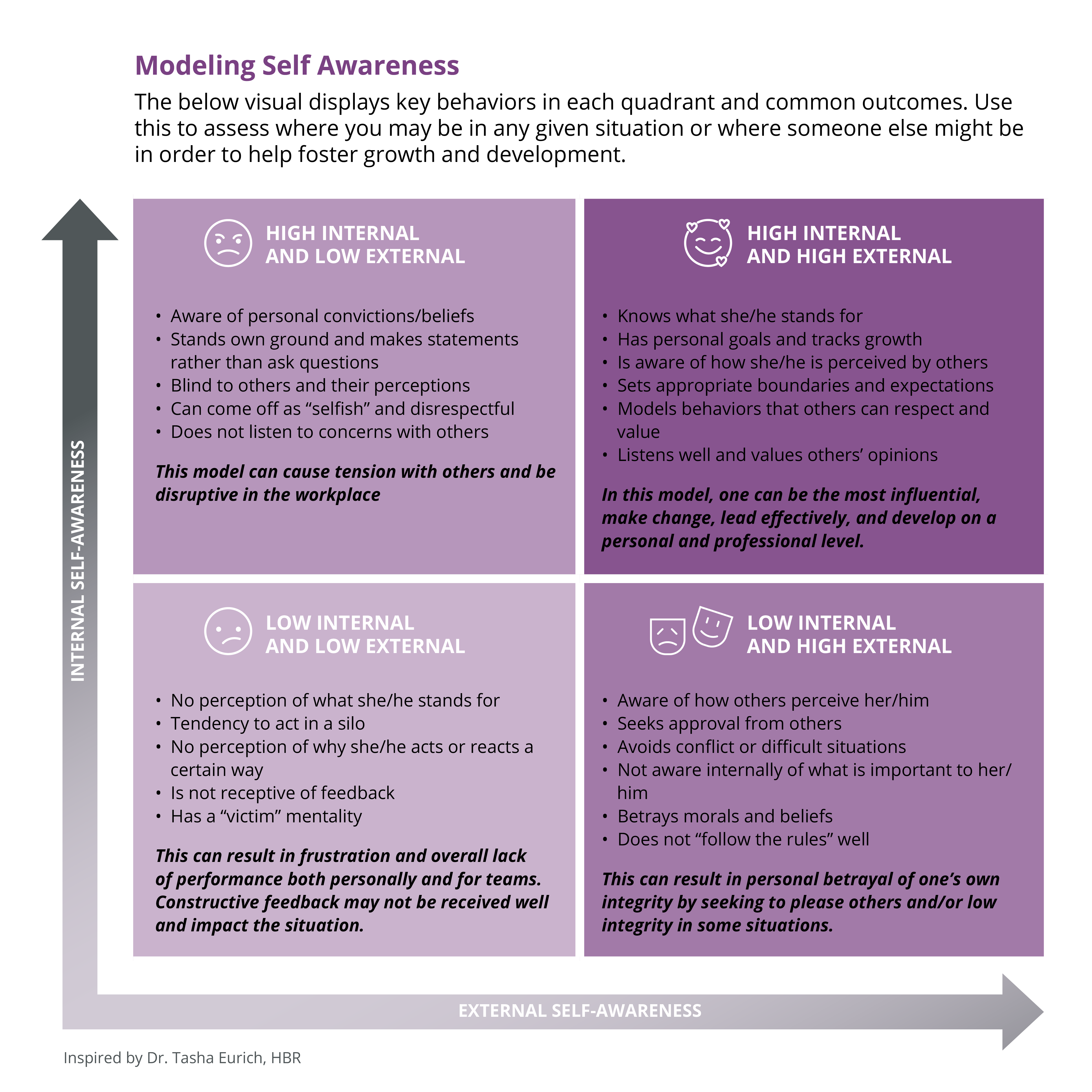
At Sendero, our leaders embed self-awareness in our competencies, culture behaviors, and core values. We actively look for ways to enhance this skill through the way we think, communicate and lead. Some effective tactics on continually cultivating self-awareness, internally and externally include:
In a fast-paced world, where information and communication travels quicker than light, we’re more at risk to miss a beat along the way – misunderstandings happen and mistakes are inevitable at every level. However, what matters more in these situations is how to constructively handle and react when something does not go right, when we are given constructive feedback, and when we are seeking to cultivate self-awareness in others. The goal is to always find a way to veer towards the model of high internal and external self-awareness. As a professional, it’s our responsibility to take a moment, and evaluate each situation we face. Ask yourself the questions below.
Probing questions to ask:
For those who manage and grow others, work with them through these questions during difficult situations to foster good behaviors. To further cultivate appropriate behaviors in others, point out situations when they might fall into either of the three models where unhealthy outcomes might lurk and direct them towards the model of high internal and high external self-awareness.
Continuously staying aware of internal and external perceptions allows for individual and professional growth, evolvement and overall fulfillment. Managers and leaders should always introspectively assess situations to determine if they fall into the gap of reality vs. perception of the self-awareness scale. Practicing effective tactics to improve and grow will result in a better communication and leading others.
awards
AwardNews
DALLAS, TX – Sendero, a full-service management consulting firm, announced it has been named to the 2026 Inc. 5000…
Read article
AwardNews
DALLAS, TX – Sendero is proud to be recognized as a 2026 Top Workplaces Culture Excellence winner across multiple…
Read article

AwardNews
DALLAS, TX — Sendero has been honored by Great Place To Work and Fortune magazine as one of this year’s Best…
Read article

CAREERS
An award-winning environment where you can create your path to a rewarding career.