HealthcareAI
The AI arms race in healthcare: Innovation without compromise
There are several key factors that healthcare organizations should consider when it comes to keeping up with the race…
Read article


Healthcare Organizational Design
05/09/2024
by Brooke Przilas

Motivated and skilled clinicians who are driven by a growth mindset are likely candidates to climb the leadership ladder. This comes with an inevitable challenge – maintaining those strong clinical skills while navigating the added responsibilities that come with a leadership role. Traditionally, clinical education and training activities focus on patient care and role-specific skills, offering minimal exposure to business concepts like operations management, budgeting, and strategic planning. How can healthcare organizations start to bridge this competency gap?
To further illustrate the topic, let’s dial into a scenario. Jack is a nurse supervisor in a post-anesthesia care unit (PACU). He’s just been promoted to nurse manager where his management responsibilities will expand to include staffing and scheduling, performance management, administrative oversight, and collaboration with other peer leaders.
Two paths could unfold for Jack:
1. Jack could quickly transition into his new role as manager, learning by experience through on-the-job training. He’d likely spend an overwhelming amount of time tracking down team members to coordinate scheduling nuances and face unexpected obstacles in managing his business unit, including maintaining a budget, facilitating crucial conversations, and upholding quality care delivery.
2. Jack could get ahead of the inevitable challenges new managers face by participating in his organization’s structured healthcare leadership development training focused on applicable and realistic coaching.
In the second scenario, Jack is able to save time and energy by proactively learning strategies that will make him an effective manager.
Supporting leadership development initiatives requires additional time and resources, but investing in upskilling your team accomplishes two critical elements. First, the investment equips team members, like Jack, with the tools to excel as business leaders, and second, it paves the way for them to spend more time providing patient care.
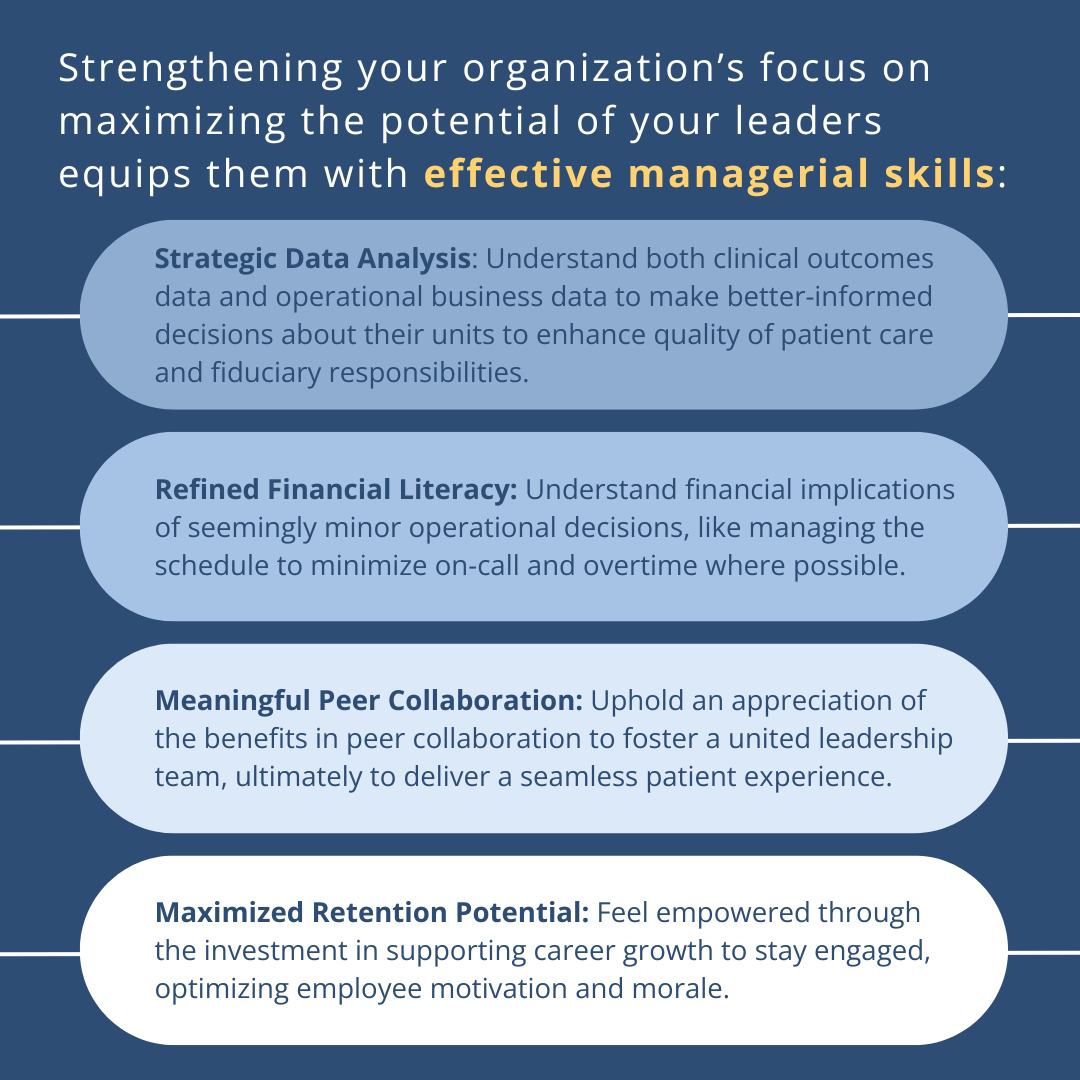
Circling back to the earlier example about Jack’s recent promotion to nurse manager – let’s review several tactical initiatives an organization could prioritize in order to to conceptualize or enhance sustainable leadership development practices for rising leaders just like Jack.
If your healthcare organization isn’t ready to invest in the implementation of a comprehensive leadership development program, don’t worry. There are still actions you can take to strengthen your leadership pipeline. One effective tactic is to create a promotion schedule, outlining key teams for new managers to engage with, like finance. This can include suggested agenda items, such as understanding budgeting processes and resources, to help position new managers to hit the ground running.
Taking steps to bolster your organization’s leadership development initiatives is an essential value driver of organizational success, helping to shape the future of healthcare delivery.
Ready to reimagine the healthcare leadership development practices for your organization? Fill out the form below to connect with one of our consultants.
Business insights
HealthcareAI
There are several key factors that healthcare organizations should consider when it comes to keeping up with the race…
Read article
Healthcare
While private equity investment in healthcare is valuable, providers should familiarize themselves with alternative…
Read article

HealthcareOptimize Technology
Advancements in health tech have allowed both patients and clinicians to experience the benefits of digital…
Read article