HealthcareOptimize Technology
Protecting patient care through advanced cybersecurity and AI
Healthcare relies on legacy processes and systems to safeguard patient care. Automation scales those processes and…
Read article


Healthcare Process Improvement
10/14/2026
by Morgan Stacell and Cami Connor

Meaningful advances in healthcare begin with collaboration. Clinicians and healthcare leaders routinely exchange ideas, compare outcomes, share lessons learned, and seek advice from peers through professional networks, conferences, continuing education, research, and other forums for cross-organizational learning. Often, that exchange happens naturally and informally: colleagues helping colleagues.
But when the requests evolve from a shoulder tap for advice and become a full-fledged opportunity to formally assess a program, broadly adopt a proven practice, or establish a capability your team has already mastered, the “phone-a-friend” model becomes difficult to sustain when meaningful time and specialized expertise are required.
The solution is not to stop sharing knowledge altogether. It is to recognize when recurring demand points to a growth opportunity that could become structured, scalable services. When structured thoughtfully, this can create greater value for both the experts providing the support and those receiving it.
New growth does not always require building a new capability. Sometimes it starts with recognizing the value of capabilities an organization has spent years developing. The strongest growth opportunities are often hiding in plain sight, particularly where expertise is already being requested, shared, or replicated.
Look for signals such as:
The opportunity could take many forms, from education and program development to assessments, implementation support, quality improvement, or specialized operational expertise. The specific service matters less initially than the pattern of demand behind it.
A simple place to start: track the asks.
Pay attention to what physicians, clinicians, and operational leaders are repeatedly asked about by peers inside and outside the organization. Capture who is asking, what expertise they need, how frequently the request occurs, and how much effort it takes to respond. Over time, tracking those informal requests can reveal patterns that would otherwise remain invisible.
Once a potential offering has been identified, the next challenge is designing how it will be delivered. Knowing how to do something well is not the same as having a scalable way to help someone else do it well. Without structure, each new engagement risks becoming a custom project that consumes more SME time than expected and competes with existing responsibilities.
Building for repeatability means defining the mechanics around the expertise. A typical engagement may move from scoping and assessment through gap identification, roadmap development, implementation, and follow-up. Standard tools, templates, roles, governance, pricing approaches, and contracting structures can support those stages without requiring every engagement to start from scratch.
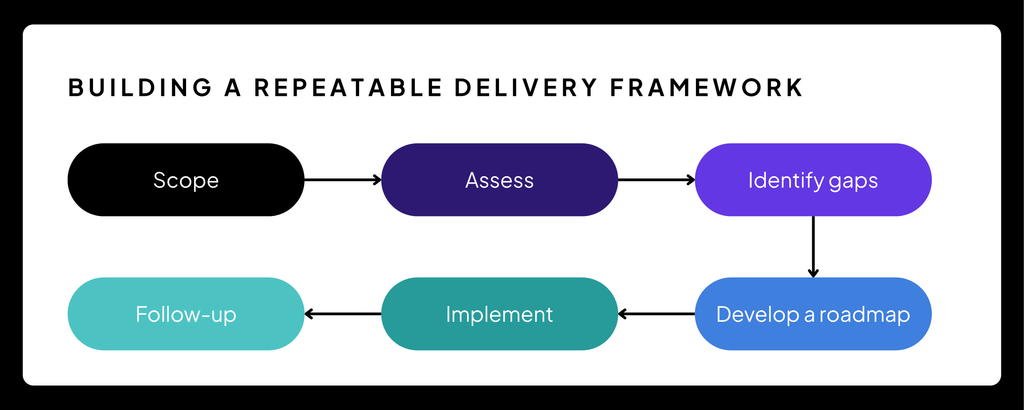
The goal is not to standardize every answer. It is to standardize enough of the delivery model to free specialists to focus their time on the decisions and insights where their expertise adds the most value.
A successful first engagement demonstrates the value of the expertise, while a sustainable model demonstrates that the organization can deliver it repeatedly without compromising the work those experts already perform.
That requires infrastructure to manage:
Formalizing expertise is not solely about monetization. Structure can also protect scarce expertise by creating clearer boundaries around when and how it is accessed. And while external demand may make the opportunity easiest to recognize, the same model can create value within a health system by allowing facilities to access proven capabilities elsewhere in the enterprise rather than independently rebuilding them or purchasing outside support.
Sustainable growth can come from making expertise easier to access without making experts infinitely available.
Before looking outward for the next service to build, health systems can start by asking:
The opportunity is not to commercialize every good idea or informal interaction. It’s to recognize where proven expertise, recurring demand, and organizational capacity intersect. Connect with us to explore how your organization can turn existing expertise into scalable growth opportunities.
Business insights
HealthcareOptimize Technology
Healthcare relies on legacy processes and systems to safeguard patient care. Automation scales those processes and…
Read article
HealthcareEnhance Customer Experience
Across patient experience research programs, the data looks positive. However, when patient trust isn’t measured, it…
Read article

HealthcareAI
There are several key factors that healthcare organizations should consider when it comes to keeping up with the race…
Read article

Healthcare
While private equity investment in healthcare is valuable, providers should familiarize themselves with alternative…
Read article

HealthcareOptimize Technology
Advancements in health tech have allowed both patients and clinicians to experience the benefits of digital…
Read article

Healthcare
The new cms-0057-f ruling will make many positive changes for the healthcare practitioners and patients, but is your…
Read article